• Hello Guest, welcome to the initial stages of our new platform!
    You can find some additional information about where we are in the process of migrating the board and setting up our new software here

    Thank you for being a part of our community!

1990 740 GLE 16V. Check engine light, rough start and low rough idle. Intermittent crank-no start.

1990 "should" have the spring belt tensioner (like the 8V) and not the hydraulic tensioner (like 960). I could be wrong. I don't know what is under the covers on this engine yet.
The B234 blocks are drilled differently for manual and hydraulic belt tensioners. I stripped down a manual tensioner block a while back, and compared it to another complete B234 in my shed which has the hydraulic tensioner.

The later B234 block with the hydraulic tensioner has little 'bumps' on oil gallery, as seen on the exhaust side of the engine, like you see on B230 'L' blocks which accommodate oil squirters from the get-go. The early B234 I tore down also had the weak skinny rods in it too.

IIRC both versions of the B234 blocks are listed under the same part number, which struck me as a bit odd, since they're drilled differently and so conversion from manual to hydraulic tensioner (or vice versa) didn't seen like a easy job. But then they did that same p/n thing with the 9mm and 13mm rods, too.....

JFTR anyway, the timing gear covers are different between the manual and hydraulic tensioner versions, which you'll already know.
 
The crank-no-start showed up one more time leaving work. Diagnostics continue....

It seemed like the fuel pump relay wasn't energizing, but I cannot be sure. I am gonna travel around with my $3 harbor freight test lamp and my $5 IPD noid light, and $25 handheld oscilloscope and see if I can catch it in the act.

The previous owner says he did NOT install a MTC crank sensor.

It would start a little bit, but when you hit the accelerator pedal it would die. The saga continues.
 
Last edited:
The crank-no-start showed up one more time leaving work. Diagnostics continue....

It seemed like the fuel pump relay wasn't energizing, but I cannot be sure. I am gonna travel around with my $3 harbor freight test lamp and my $5 IPD noid light, and $25 handheld oscilloscope and see if I can catch it in the act.

The previous owner says he did NOT install a MTC crank sensor.

It would start a little bit, but when you hit the accelerator pedal it would die. The saga continues.
My 940 started randomly stopped starting, crank, spark but no power to injectors. One day started perfect but since then 2 months and still doesn’t start. I think it’s the ECU because I already checked many things
 
I have been having intermittent issues with stalling at idle. It would sometimes start back up and run fine, other times it won't stay running with throttle. I pulled a (1-2-1 MAF) code and was able to drive it home.

Today, it started and stalled and I couldn't get it to driveable condition. I pulled the following codes.

3-1-2 (EZK load signal), 2-2-1 (fuel trim off-idle), and 2-3-2 (fuel trim at-idle).

I am gonna shotgun a MAF at it. I haven't really done much diag.

UPDATE: The engine was consistently stalling and running like crap today. I wiggle tested the MAF wiring and then it started running normally. I just drove it without issue. I think I am onto it! I have a replacement used MAF on the way. I will also perform terminal tension (drag test) on the MAF female terminals and make sure the terminal tension on all the terminals are not loose. I have a feeling it is a failed MAF. The airbox mounting rubber insulators are missing.
 
Last edited:
Confirmed good terminal tension at the MAF connector female terminals with the proper test probe.

I found a used Bosch MAF with a white Bosch sticker on it in my hoard of RWD parts. I installed the used MAF and all is well so far. No stalling, crank-no-start, or poor idle.
---------------------------------------------

I SPOKE TOO SOON. It did a crank-no-start/stall in a parking lot after a 15 minute drive. It threw a 3-1-2 (EZK load signal). It is idling like crap and sometimes stalling at idle. High idle/low idle, but had no problems at freeway speeds.

I am not sure which diagnostic direction I am going to go right now. All I have noticed is the battery isn't held down and it is tugging on a corroded ground cable that goes to the frame rail.
 
Last edited:
I drove the car around yesterday and today and cannot duplicate the crank-no-start/stall or poor idle. I checked codes today and I had a 3-1-2 (EZK load signal) stored in socket 2 for the ECM, but no CEL was ever illuminated.

I unplugged the knock sensor today and after a short drive I got the a CEL and the EZK reported code 1-4-3 for the knock sensor. Plugged in a test sensor, but did not mount it to the block. I got the 1-4-3 and a CEL after a short drive.
 
Last edited:
First off, like fastcatbestcat said, that loose connector is likely for a non-existent EGR valve that would live down below the intake manifold. If the ECU is designed for an EGR setup then if the connector is off it should throw a 4-1-3 code on socket 6, "EGR temperature signal absent or faulty". Double check to make sure it's not for the knock sensor under the intake manifold, although that should throw a 1-4-3 code on socket 6 if it's disconnected, "Knock sensor signal absent or faulty".

As for your on-going idle and stalling problems, after all you've done I'm suspecting your throttle body may still not be set up quite properly, especially the throttle stop screw, possibly also the TPS even though it's clicking. It's easy to have some little thing slightly out of adjustment that creates idle problems, even intermittent stalling problems. Coincidentally, I learned these lessons the hard way over 30 years ago tinkering with my new '89 740 GLE 16-valve and not knowing enough about what I was doing. If the engine starts idling too low, that's a sign the ECU is not getting the TPS signal or the IAC valve is sticking. If it stumbles and stalls while idling low it can throw the occasional diagnostic code, such as a fuel trim problem or missing rpm signal. These can be red herrings leading you to think the problem is elsewhere when actually it's a side effect of the low idle stumbling and stalling. I once had that happen on a B234F when I was having idle problems. Whenever you get a code, especially in these kinds of circumstances with multiple codes, it's always best to reset the codes and see if the same codes come back before starting to worry about what the code might be telling you.

Going back to basics, I'd double check to make sure your throttle body is correctly adjusted as per the Volvo procedure in TSB 25-202 (link is above). Once everything is guaranteed set up correctly, if you have any further idle/stalling problems then you know it's likely elsewhere, not at the throttle body. I'll summarize the details here from my notes. Please try to follow them step by step to double check the way yours is set up at the moment.

=== Throttle Body Clean, Check & Adjustment - 240/700/900 LH 2.4 B230F/B230FT/B234F - Tips & Techniques ===

1) Make sure the PCV system and throttle body are clean. Remove and clean the flametrap element, check that the small hoses and plastic nipple are clear (the plastic nipples become brittle, be prepared to replace the flametrap if you accidentally break it), remove and check that the brass nipples on the TB are clear as well as the small holes in the throat (use a small drill bit as needed to carefully ream out any grunge being careful not to widen the holes). Make sure the throttle plate is clean, especially the edge, and clean the throat, especially the area around the plate.

2) Check the plate isn't binding. When idling unevenly, too high or even too low, try forcing the throttle closed by hand to see if that makes a difference. Optionally, best to remove it and hold it up to the light, sighting through for an even band of light around the plate to make sure it's centered. Also optionally, with the engine idling, spray carb cleaner or even water around where the throttle shaft comes out of the body; also try it while pulling/pushing on the shaft; if the idle changes then the shaft bushing is worn and letting in unmetered air, so should be repaired/replaced.

3) Readjust the throttle plate stop screw. Loosen the TPS and pop off one end of the linkage rod so they don't affect adjustment. Loosen the stop screw lock nut and back the screw off a turn or so. Now with your fingers holding the throttle plate firmly closed (rotate the TPS if needed), advance the screw until it's touching and you feel the throttle plate is just about to open, then advance the screw 1/4 turn more and secure the lock nut without moving the screw. This keeps the throttle plate partly open when your foot is being taken off and on the gas pedal as the IAC valve takes over.

4) Readjust the TPS. It needs to be adjusted for the click; if set on the hairy edge it can lead to an inconsistent idle and occasional stalls; if overadjusted it can lead to rpm dips and hiccups when taking your foot off and on the gas pedal. Start with the TPS loose and advanced clockwise away from the click. For a Bosch TPS, holding the throttle plate closed, rotate the TPS counter-clockwise past where it clicks until it reaches end of travel then secure in place. For a VDO TPS, insert a 0.25 mm feeler at the stop screw (a strip of heavy bond paper will do) then rotate counter-clockwise until you just hear the click and secure in place. Optionally, you should use the OBD system to verify that the ECU is seeing the TPS closed signal, verifying both the switch and the wiring connections using Diagnostic Test Mode 3 (DTM 3) on socket 2 (refer to the OBD section of the 700/900 FAQ on the UK club website, it's a very easy procedure requiring no tools or even getting your hands dirty).

4a) Another useful thing the OBD system can do is while you have a nostart happening. You can use DTM 3 to verify if the ECU can see the CPS/RPM sensor signal, confirming that both the CPS and wiring connections are okay and not the cause of the no start. Even a relatively new CPS can fail or become intermittent, especially a cheap one and especially one that's subject to abrasion or excessive flexing (the orginal Volvo CPS came with cable standoffs to prevent scuffing and flexing, some aftermarket CPS also come with them). If you're lucky a CPS can last a couple of decades, but I've recently had a supposedly high quality OEM name-brand one fail in less than a year. I always have a known good spare on hand to try swapping and they only take a few minutes to install, especially on the 700/900s as there's more room to work between the engine and firewall than the 240s.

5) Re-connect and check the linkage rod adjustment. The rod should not be adjusted tight, there needs to be a little slack so the TPS can easily click. With the throttle closed there should be a small gap between the throttle spindle (cable pulley) and it's stop on the body. Optionally, you can adjust the linkage rod to spec, inserting a feeler (a strip of heavy bond paper will do) between the trottle spindle and it's stop, adjusting the rod shorter until the TPS no longer clicks, then adjusting it longer until it just clicks with the feeler still inserted. The spec for a 700/900 B230F/B230FT is a 2.5 mm feeler, while the spec for a later B234F is a 1.6 mm feeler, but it doesn't really matter as long as it clicks with a thick piece of paper in the gap.

6) Check throttle cable adjustment (gas pedal cable) so there's a bit of slack in the cable. Some think there should be no slack to maximize WOT air intake, but that's incorrect as the cable needs to expand/contract and flex without affecting the TPS. There's a spec for adjusting the cable measuring freeplay at the pedal.

7) Optionally, if you've got an automatic you can also readjust the trans kickdown cable (refer to the 700/900 FAQ on the UK club website).
================================

Based on my years of owning a B234F, they seemed to need more frequent cleaning of the throttle body, PCV system and spark plugs to keep them idling smooth, especially if you do a lot of city driving as the B234F typically operates at a lower rpm in the city compared to other red block automatics. I found using premium, top-tier gas and an occasional good long highway drive at higher rpms (what people called an Italian tuneup) can really make a difference with these engines.

How do you like the AW72L transmission? It's basically an AW71L transmission used by the B230FT and later B230F, with different gear ratios to better match the skewed torque curve of the B234F 16-valve DOHC. Compared to the AW70/AW71 gearing, I and others found they perhaps went a little too far, making 1st gear a bit too low (more easily spinning wheels on stop lines and wet pavement) with a bit too large a gap between 2nd and 3rd. The lockup feature works well with this powerful engine on the highway allowing you to pass without always kicking down to 3rd.
 
The engine has only acted up 3 or 4 times in the last couple of months. I just keep starting the engine, or let it sit for a couple minutes, and then it fixes itself and the engine will run and drive fine.

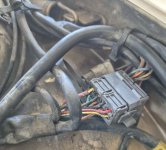
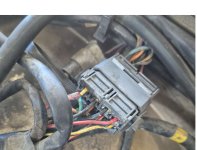
The issue is so intermittent I am just documenting my findings and working on diag. Right now it drives fine. The engine wiring harness is suspect. I have found an area behind the power steering reservoir where the terminals have lost the rubber bullet connector insulation.

I like the AW72L and 4.10 rear gears. I also like the high RPM pull on the 16V. It snaps your head and sometimes chirps the tires going into the next gear.


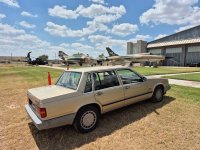
744GLEairfieldresized.jpg
 
Last edited:
It would randomly run. It didnt' run well when it did run. Set the load signal missing code. I know he tried various ECU and EZK replacements. But it's a wiring or connection issue. Right up his alley. Wish Zvolv well with the car. It's a nice one.

I found this post today in my other thread. BIG CLUE!!!!! It still throws the "EZK load signal code" when it does its bullshit.

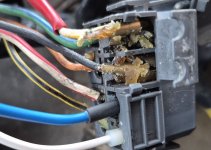
Last week, ONE TIME the engine was idling and running like crap and I wiggled the wiring by the MAF and it started running well. The wiring behind the power steering reservoir has the decaying rubber insulation for the bullet connectors. I am going to start replacing the female leads. Pretty much all the rubber insulators on the wiring are degraded in the engine bay. Brake fluid level switch, washer pump, etc. I fixed the decayed wiring insulation for the RSR relay already with a Dave Barton connector with wiring leads. I am gonna have to go thru and do about 50+ new wiring leads.
 
Last edited:
Looks like a likely location to cause strange intermittent issues. Good catch.

I plugged it all back in and pushed the wires in the best I could. I lost the temperature gauge after messing with that connector today. Went for a drive and got more diagnostic information on the overdrive cutting out.


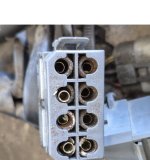
Well, the car is dead in front of my garage door right now. Starter won't go now. It is probably one of those 8 wires in that suspect connector. Once you pull those corroded wires apart, they never really go back together well again. I am gonna get some new wires coming.
 
Last edited:
WiringRepair.jpgWiringRepairLeads.jpgWireRepaired.jpg


--------------------------------------------


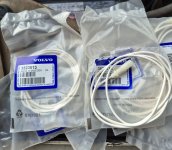
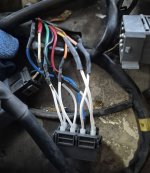
I repaired the wiring tonight with some OEM repair leads from IPD that I had "in stock" in my Volvo parts hoard. I used one blue terminated lead I took from a Dave Barton four terminal connector since it was a slightly larger gauge wire than the rest. I soldered and heat shrink tubed the wires and then wrapped it all with cloth electrical tape.

After the repair, I got my starter back and got the temp gauge back. The engine is running excellent so far.
 
Last edited:
The crimps were corroded. A few of the wires were stiff at the end from getting warm from the excessive resistance in the circuit. The male and female bullet terminals also had some green corrosion on them.

I think that red/white wire is for the ignition coil. The crimp was corroded and green.
 
This thing has been running perfectly for a couple tanks of gas. Low end power feels much better too. However, today I was accelerating up the street and it just lost power and went "flat". Engine stayed running while I was in gear, but it stalled once I let it get down to idle speed. Crank-no-start a few times and then it started up and I drove straight home with no issues.

It almost acted like a fuel restriction. The fuel level sensor was just above the red.

Diag continues.
 
Last edited:
I got the crank-no start to show up again yesterday. I did some errands, parked at home, came back out and it was doing the same old intermittent BS. It's doing the same old thing where it will kinda start and idle, but the second you hit the accelerator pedal, it backfires thru the intake and dies.

You can sit there and crank and it may kinda start. Then just come back a little bit later, or keep trying, and then it will jump back to life and run fine for days/weeks. I can tell that the previous owner/s haven't been able to figure this one out and have been throwing parts at it like fuel pump, fuel pump relay, crank sensor.

I got brand new tires on it and fixed the alignment. It was toed in like 1.2 degrees on each side. The tires would squeal around corners and it chewed the outside shoulder off a tire in like 500 miles.

I am still riding around with my test lamp, injector noid light, and my $30 scope and trying to get it to act up long enough to diagnose. I am going to confirm power and current to my fuel pumps when this is acting up. Spark, and injector pulse too. I need to rig up a remote starter wire so I can be alone and under the hood and crank it with the key on.

I also haven't checked what is going on inside the tank or really done any tank pump diagnosis. Or any fuel pressure diagnosis. I gotta rig up a pressure gauge since the B234F rail has no schrader fitting for checking fuel pressure. I am gonna do some research on what people have done here to adapt in a gauge. Cleanflametrap I think rigged up something, maybe it was using parts from an old fuel rail....


EDIT-After posting the above rambling, I went out to the car for test drive and found 3-1-2 code stored in the LH unit. No check engine lamp illuminated. At this point, it seems like when the crank-no-start is happening it stores this code with no CEL. At least I have a diagnostic direction to follow.
 
Last edited:
Hmm, first off, code 3-1-2 (missing knock sensor signal from EZK) by itself indicates a wiring or connector problem between the EZK ignition module and the ECU. It does not set the Check Engine light. If there's a problem with the knock sensor itself or its wiring (like a loose connector on the sensor) then you should get a 1-4-3 code (missing/faulty signal from knock sensor) on port 6, which does set the Check Engine light. As you're not getting the Check Engine light then you're likely not getting a 1-4-3 code thus the problem is between the EZK module and ECU, so I suspect it's a connection issue. If you've had either of those connectors off for testing with a meter and probed into the connector pins then the pins can get easily bent (they can be straightened with a pin, disconnect the battery first). Always probe into the sides of the connectors, not into the pins. If the engine has been slightly backfiring then it's possible, although not overly likely, that might have triggered a weak knock sensor response that the EZK module was willing to accept, but the ECU didn't like that signal when it was passed on from the EZK. Note that the ECU does not get its signal directly from the knock sensor.

An intermittent no-start still suggests a problem with the CPS. You will rarely, if ever get a 2-1-4 code (port 6) or a 1-3-1 code (port 2) with a no-start due to a bad CPS. Those codes are only raised when the engine is running and the signal goes missing. A frayed broken wire inside the cable often has intermittent contact, especially initially. Numerous times when I've had a CPS go bad I've sometimes gone weeks, even a couple of months with no starting problems at all then all of a sudden it won't start followed by a few intermittent no-starts over the next few days/weeks, then it can be normal again for a couple of weeks. Something as simple as touching the cable can make a difference with intermittent contact of internally frayed wires. I'd definitely want to swap in a known good CPS even if the CPS is relatively new. I've had a decent Facet CPS from Italy fail within 13 months and heard of cheap CPS from Asia failing within 1-3 months. If the engine has been rocking around then the CPS gets increasingly flexed, hardening the fine copper strands so they become easier to break. Do you have the original standoffs to keep the cable from flexing at the bell housing or scuffing against the return coolant line from the heater valve? There are two of then on the return coolant line. They're there to extend the life of the CPS cable. If the standoffs are broken or missing (as they often are), you can make your own using a figure 8 zip tie inserted through a short piece of vinyl tubing as a spacer. A decent zip tie will last a good couple of years before breaking and needing replacing. Both the Volvo CPS and Facet CPS come with new standoffs. The Bougicord CPS don't, leastwise they didn't use to.

Backfiring can certainly be a timing issue, but it can also be a valve issue. If you were having intermittent CPS problems and getting a 2-1-4 (or 1-3-1) code then you could in theory have both the injectors and spark plugs momentarily shut down and cause backfiring and engine knocking. Not that it's a likely issue for you, I'll mention the early 1988-1989 B234F coils were also known to be a bit weak and cause poor performance and even occasional missing, but the later 1990- coils were upgraded. When I was having performance problems, I upgraded my coil, but it didn't make a difference.

Are your valves noisy after starting? How long does it take for the ticking to go away? If the hydraulic lifters are starting to get sludge inside then they can take longer to pump up until the oil gets hot and they stop ticking. As my B234F aged it used to like more frequent oil changes and using a good synthetic to keep the ticking at bay. Now if the hydraulic lifters actually get plugged, the valves may not open and possibly cause backfiring. Additionally, the B234F is an interference engine and the valves can get either badly damaged or even slightly damaged if the timing belt breaks. This could have happened to a PO, but you'd likely have noticed backfiring due to valve damage long before now.
 
Last edited:
Thanks for the reply.

In post #46 I made a post about my testing with the knock sensor unplugged and also with a "dummy" spare sensor I plugged in. I got the 1-4-3 (knock sensor missing signal missing). I think I remember driving with the dummy sensor plugged in, but still not mounted, for a day or two. CEL illuminated. I recall driving 15 minutes away. Turning off the engine and then tried to restart it and the same crank-no-start was present. That tells me the knock sensor on the block is not the problem.

The 3-1-2 (load signal missing from EZK) code seems to be the only code that I can get it to throw anymore. I accessed the EZK box and performed a terminal tension test on the EZK terminal and the LH box wiring terminal with the correct test probe. I also had close to 0 ohms end-to-end on this circuit. I did not do a voltage drop test on this circuit, but I simply confirmed it was not an open or high resistance.

The EZK box appears to have been swapped out at one point. There is a spare that came with the car in the trunk. Also, the EZK box is not properly mounted to the brake pedal bracket. I admit that the last person had some troubles getting it mounted to the pins and replacing the screw that secures it. I think the plastic connector is even touching the steering shaft slightly, but there was no wire chafing visible. I plan to get my ass under the EZK box sometime soon and maybe remove the current box, do some additional testing on power, ground and the signal circuit. I also may try that spare EZK box and will also get it mounted properly.

I did some research last night using the diagrams linked earlier in this thread. There appear to be only three wires that connect between LH and EZK.

-I have also replaced the crank sensor with a fresh bougicord sensor

-The engine is a Volvo reman installed at an unknown date mileage. The timing belt was done in 2022 at an unknown mileage. No ticking lifters or any indication of loss of compression, but it is something to consider. It really just seems like an intermittent electrical issue at this point.

LH terminal 1- receives RPM signal from EZK
LH terminal 25- load signal from LH to EZK
LH terminal 28- knock enrichment from EZK to LH

The 3-1-2 code seems to be defined as load signal missing FROM the EZK box. I don't understand quite what that means because EZK doesn't send any LOAD signal over to LH box. The only signal it sends over would be knock enrichment. Maybe I am just confused right now. I don't think the knock sensor circuit is my issue, but I haven't ruled it out.

Anyways, I am gonna do some backprobing at my LH terminal 28 and maybe hook up the meter and/or scope and see if I can get an idea of a good signal. Then see if I can ever get the issue to duplicate and see if I have a bad/missing signal at that point, which could be the EZK box itself or possible poor wiring somewhere in the dash between the LH and the EZK box. I could also try running a new circuit between the two boxes, but I would rather do that last.
 
Back
Top